All-In Equity Graphs
Overview
Players in online forums often discuss the EV (Expected Value) of a decision. True Expected Value is a forward projection of winnings that accounts for the entire range of hands an opponent may hold. Software can't accurately determine that range, so EV could only ever be calculated in spots where the players were effectively all-in — and the term "All-in EV" was born from that workaround.
PokerTracker 4 moves away from "EV" and "All-in EV" because those names are misleading: they describe a results-oriented stat, not a forward-projecting one. In their place, PokerTracker 4 introduces All-in Equity and All-in Equity Adjusted Winnings, which describe the stat more accurately and improve its precision. This guide explains how the terms differ, why the change was made, and how to read graphs that use these stats.
All-in Equity vs. All-in EV
Both terms answer the same question: in an all-in situation, what would the result be if no more cards were dealt and each player was instead returned their equity in the pot? Both are calculated by subtracting the total amount you bet from your equity in the pot.
The difference is in the name. "All-in EV" is technically incorrect:
- True EV measures the equity of your hand against an opponent's range of hands. That projects the expected value of a decision.
- All-in EV uses the opponent's actual hand, which turns the figure into a measurement of how the remaining cards fell — luck, not expectation.
All-in Equity is the more accurate title: it takes the all-in hands, calculates each player's equity share at that point, and can only be computed when every active opponent's cards appear in the hand history. To improve precision, All-in Equity also ignores certain situations that PokerTracker 3 included in its All-in EV calculations, making it a cleaner measurement of luck.
For more on the subject, Jeff Hwang's article The Problem with All-in EV / All-in Equity — originally published in Card Player Magazine and re-hosted on the PokerTracker Blog by permission — covers it in depth.
What Is Equity in the Pot?
Equity in the pot is the percentage of times you expect to win the pot, multiplied by the size of the pot. It tells you how much of the pot you would get if the cards were run an infinite number of times.
Consider this example. Hero has AA and Villain has KK, with Hero's suits dominating. Both are all-in before the flop for $100 each, so the total pot is $200 (we'll assume the blinds cover the rake to keep the math simple). Hero wins 82.6% of the time, so:
- Hero's equity in the pot is $200 × 82.6% = $165.20
- Villain's equity in the pot is $200 × 17.4% = $34.80
If the players are all-in on the river, or one player is already guaranteed to win, equity and actual results are identical — there are no more cards to come.
What Does the Graph Show?
In the example above, both players put $100 into the pot, so Hero's All-in Equity is +$65.20 ($165.20 − $100) and Villain's is −$65.20 ($34.80 − $100).
- If Hero wins the hand (Figure 1), his Amount Won rises by $100, but his All-in Equity line rises by only $65.20.
- If Hero loses the hand (Figure 2), his Amount Won drops by $100, but his All-in Equity line doesn't change.
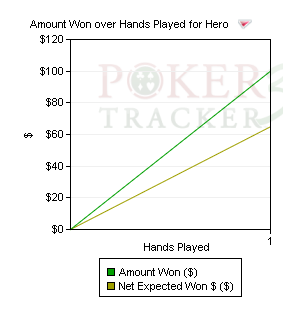 | 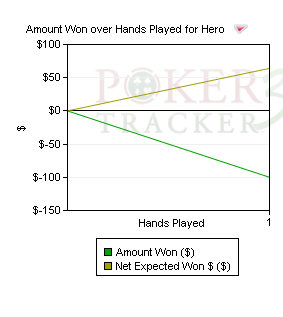 |
| Figure 1 | Figure 2 |
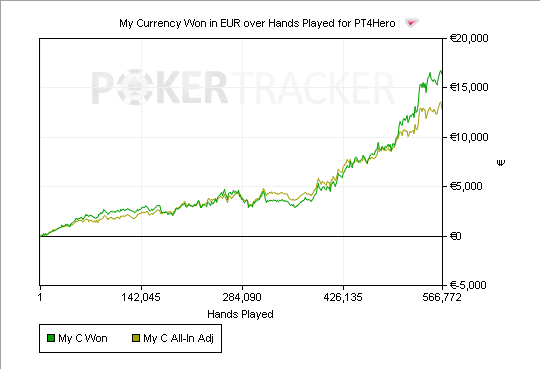
For hands that were not all-in, the All-in Equity graph shows your normal results. For all-in hands, it shows your All-in Equity instead of your actual results.
When in the Hand Are These Calculations Performed?
The calculation is performed at the point of the all-in. If, in the example above, the all-in didn't happen until the flop and the flop came K72, Hero would expect to win just 8.6% of the time instead of 82.6% — a drastically different result.
What About Multi-Way All-in Pots?
When every player has the same stack size, All-in Equity is calculated for each player exactly as above.
When stack sizes differ, All-in Equity ignores the hand entirely. Here's why. Consider three players:
- Hero — $100
- Player A — $900
- Player B — $1000
Hero open-shoves for $100 with QQ, and both Player A and Player B call. The flop is KQ3; Player A bets $150 and Player B calls. The turn is a J; Player A bets $500 and Player B folds. Player A shows AK, the river is a T, and Player A wins.
At what point should the All-in Equity be calculated?
- Preflop? We don't know Player B's hand, so the calculation would be incorrect.
- On the turn, after Player B folds? Hero's money went in preflop, not on the turn — and the turn action is influenced by cards Hero never committed against.
There's no correct point to measure, so neither answer works.
PokerTracker 4 excludes hands like this from All-in Equity results. There's no complete, correct way to calculate them, and reporting a misleading number would be worse than reporting none.
What About Unknown Cards?
PokerTracker 4 excludes any hand with unknown hole cards from the All-in Equity calculation. This covers the multi-way case above (all-in preflop against two players, one of whom later folds) as well as hands on sites that don't show mucked hole cards. Without every player's cards, the result would be incorrect and would skew the graph.